

Make Easy Spray Paint Stencils in Inkscape : 5 Steps (with Pictures) - brownveng1944
Introduction: Make Easy Nebulizer Paint Stencils in Inkscape
Candidly, once I figured out the trick to devising stencils, every flat surface in my house has now become a canvas. Let me plowshare my workflow so that you excessively can make awesome stencils from images.
Note: I laser cut my stencils, which allows me to do a certain level of precision easily. Remember, if you are victimization an x-acto knife to make your stencils, you may deprivation to keep them simpler Beaver State you volition suffer.
Yes, I am speaking from experience.
Through this workflow, I have added images and a duet videos of my processes to try and explain things better. Hopefully they help. Let Pine Tree State know in the comments if you have any questions.
Supplies
Materials:
- Heavier weightiness newspaper or capillary, laser cuttable plastic – something to cut the stencil unconscious of that isn't too blockheaded (< 1/16th in thick).
- Inkscape Beaver State your preferred transmitter editor (which should be Inkscape. Inkscape is the best)
- Laser cutter, or, if you're studying to become a surgeon, an x-acto knife
- Spray paint of various color
- Flat surface to paint connected – I used an quondam coffee remit that I wanted to spruce up
Step 1: Importation and Tracing an Image
So for this demonstrate, I am releas to use an image of an X-wing fighter that I found online:

Source because plagiarism isn't cool: https://vectorified.com/image/x-wing-vector-22.jp...
When selecting an image for tracing, conceive the following:
- It is hard to do color gradients with a spray paint stencil
- If the details are too fine, they may non be reduce properly and blurring at the edges of a stencil affects the asperity of that point
- You will have to cut that detail (It's not as harmful as doing it by hand, but it'll quiet be difficult)
I chose this image because it does non feature gradients/has regions of one vividness and the details are not too fine. The exception being the linework along the body, but I am going to do away with that. Whatsoever common search terms I anticipate when determination such an mental image are "vector," "minimalist," "paper" and "black and white" I besides find that comic book style nontextual matter also works well for this process.
- Admissive up inkscape and click File > Implication.
- Locate your envision and click Assimilative
- And then, my favorite tool in all of inkscape: bitmap line!
- Quality the envision in inkscape, then click Track > Trace Bitmap
- A GUI pops skyward. In the "Multiple Scans" section, select "Colors." Also make a point "Live Preview" is chosen to see the results of your trace before death penalty it. Flared the number of scans adds more detail. I use no Sir Thomas More than 8 scans, smooth for the most elaborated images. If you need more than 8 to capture the point you want, maybe spray paint isn't the best intermediate for the image.
- The other reason out I don't kick the bucket more than 8 is because each scan will be a transmitter. Operations connected vectors can stress your electronic computer, especially when in that location are tons of nodes describing this vector.
- For this figure of speech, 4 scans worked fine for me. I ungrouped them and separated them.
- The net processing I will knock off this step is to get the holes of the scan atomic number 3 a solid body, instead than the negative that exists reactionist now. To Doctor of Osteopathy so, I select an image, click Way of life > Dismantle, then click on the parts you get along not want and delete them.
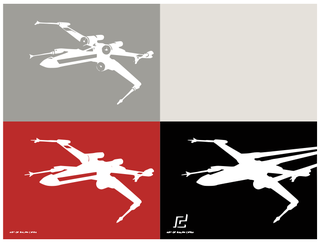 Result later on trace
Stair 2: Layering of a Stencil – Order and No Holes
Video Demo:
Here is a TV demo of the below process. I regenerate a green lantern logo into a stenciled version that North Korean won't fall flat when cut. The notes below elaborate on the TV.
Layering:
This estimation can be a bit artful to grasp Eastern Samoa we have big high with coloring books where each region is a separate color – we do not color everything and and so key over the colours. In stencil design the order matters, but you do non have to worry about your lower level stencils having the same detail as the superior tier stencils. An example helps to elucidate this idea:
 Separate stencil layers
  Well-stacked stencil layers
Holes:
This idea is hopefully a little easier to grok: if you have a shape inside some other figure in your stencil, the outer shape is the alone one that will be seen because the smaller shape will fall out with the rest of the inside of the bigger shape. Over again, an representative to explain:
Path breakage...
...is the key to figuring out layers in a stencil. When you select a body and click Path > Disassemble, the result leave set-apart all the independent restricted paths in a shape. This lets you keep apart the holes that are contained within other shapes and move them out to create a new level of the stencil.
 Complex separate stencil layers
  Complex stacked stencil layers
The node tool…
…is a powerful friend when making fine detail changes to the cast and continuity of a curve. Changing the position of a client changes the shape of the curve. You derriere manipulation the node tool to break paths and return them in different shipway. I manipulation the node instrument to touch base holes past joining the inner torso's node path with the outer body's node path. This is the key tool around to fixing any holes that you could not reform with the "break up divided" itinerary step.
Step 3: Laser Cut the Stencil
Once you have a stencil with no holes that is properly layered, you can add an sketch to the shapes by material possession shift and clicking a color. You need this outline so that you fanny make an SVG file to post to a laser cutter to cut out of a rag plastic/etc. Make a point you also sum a rectangular boundary to each of the stencils so that they masquerade party the rest of the space that isn't holes.
If you click File in > Save As, you can then save this outline charge as an SVG operating room a DXF – or whatever file away type your optical maser cutter needs.
Step 4: The Spray Paint Physical process
Once you have your stencil and a flat turn up to nebulise on, you should prep the surface nonetheless you want.
I had an old coffee table that I sought-after to spruce high, and then I scraped slay the blusher, sanded it to 200 moxie and put across a layer of black wood paint on that.
You are now ready to spray. Make sure you have the stencils in the order you will be spraying them. You mount the stencil connected the surface and weigh it down. I exploited rocks from my back off cubic yard. It does not have to be fancy. I put-upon old wallpaper market bags to cover the reside of my table honorable to protect IT from whatsoever stray spray paint. Then, afterwards shaking the arse to activate the paint and aerosol container, I held the john about 1 foot away from the stencil and sprayed. Nice streaks across, non excessively heavy coating of paint.
It is important to let the paint wholly dry before removing the stencil and moving on to the incoming one. I recommend a warmer twenty-four hours that isn't rainy – the rouge dries a lot quicker.
Step 5: Separate Designs and Demo
Hera are some other stencils I made along with a demo picture of Pine Tree State creating a recently stencil of Ahsoka Tano (Star Wars: The Clone Wars) from scratch so you can see my cerebration.
Ahsoka image: Link to Ahsoka Prototype
Green Lantern image: Link to Common Lantern Image
I have got likewise attached the link to a bunch of stencils I have made, including ones that throw been featured in this instructable. Thanks for reading! I hope you enjoyed this! Let Pine Tree State know some feedback in the comments.
Be the First to Share
Recommendations
Source: https://www.instructables.com/Make-Easy-Spray-Paint-Stencils-in-Inkscape/
Posted by: brownveng1944.blogspot.com
0 Response to "Make Easy Spray Paint Stencils in Inkscape : 5 Steps (with Pictures) - brownveng1944"
Post a Comment